Showing posts with label fo. Show all posts

Mar 24, 2015

Symptom No.3: Lucky (me)

Here's the third and last report (for now) of Solenn fever.

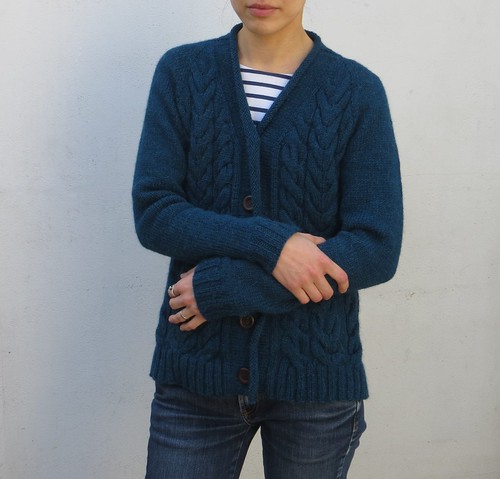
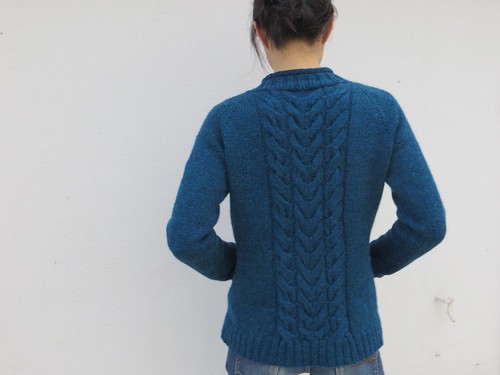
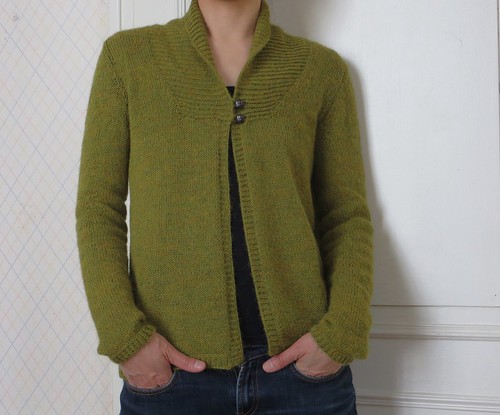
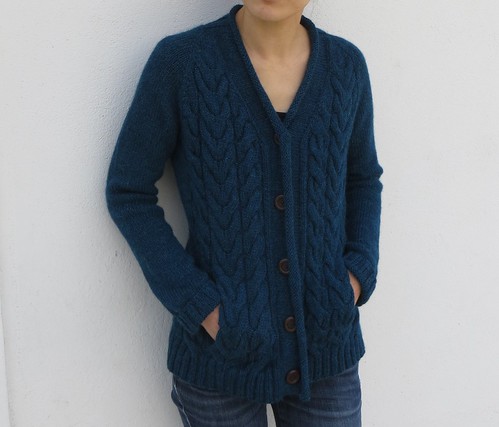
This raglan cables jacket, named Lucky (me), is the pattern I'd wanted to knit for one year. I translated it into Japanese last year and it was a smash hit of my online store. And I loved knitting it! It's worked from the top down, you increase for raglan and fronts and incorporate as you go the cables (worked symmetrically). After the waist shaping, you make these pockets hidden in cables, it was really fun!


The details are really well thought too. At the very last row of cables, sts number is adjusted so that cables flow into ribbing. Two sides of pocket lining are knitted with the body, you just have one side to seam. Buttonband is worked in St st, but the back neck you don't sew buttons on is worked in ribbing to keep the edge from rolling up overmuch.
And I just followed literally the instructions, it's fuss-free!


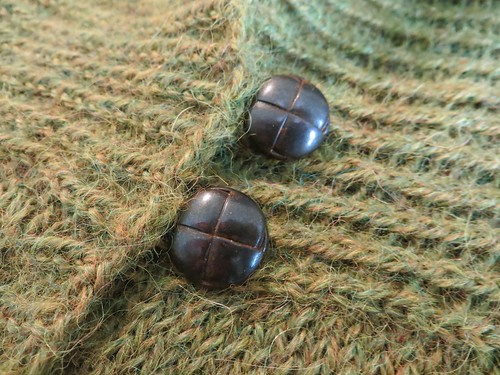
I used Lima from Drops, a lighter version of Nepal that I used for Quadrature for Korrigan. As the latter, it's warm and cozy, slightly fluffy (and very reasonable). For the buttons, I chosen dark wooden ones that match this stylish simplicity of the jacket. They are from La droguerie.

We had some sunny, warm, springlike days in the northern half of France at the beginning of March, but it's gotten cold again, I'll have some chances to wrap myself up in this jacket, lucky me!

Project Data
Pattern: Lucky (me) by Solenn Couix-Loarer
Yarn: Drops LIMA: #701, appx 1230 m/1340 yds (Size M1)
Needles: 4.5 mm/ US 7 and 4 mm/ US 6
on Ravelry | in Japanese


Feb 23, 2015

Symptom No.2: Quadrature for Korrigan

And here is the second report on Solenn fever.

This symptom named Quadrature for Korrigan keeps you warm and also keeps you from breaking away from the fever, especially when you'd already had precursors such as
 ,   and   .
The Quadrature is a part of All Korrigan, which contains baby cardigan, girl cardigan, hat for all the family and this baby blanket, and whose hallmark is these beautiful decreasing cables.
We have no baby but I'd wanted to make this blanket for a long time, and here's why.

Isn't it lovely?

This project has two totally different phases. You begin with a few stitch from the center and work in the round in St st, increasing beside the axes as you go. This phase is perfect for TV knitting, while the final border demands more concentration with p rnds and cables (and increases). Needless to say it's rewarding and through the St st part, you're looking forward to working it.
I had some problems concerning the proportion to keep for this border.
This pattern offers a bonus version for adventurous knitters who want to make a larger blanket, work with other gauge and/or knit larger cables. As this blanket is for us, I'd bought 825 m/902 y of yarn (instead of 625 m for baby blanket) to make a larger one.
Well, the more you work in St st, the less proportion you need to keep for the border as the number of rnds is fixed (34 or 50 rnds). But when your yardage is limited, you need to find the point (=the proportion) to begin the border in order not to run short of yarn. I realized too late that I'd worked in St st more than I had to (7 balls of 11, more than 63%), whereas if I'd work larger cables, I needed to stop at 40% (60% for the border). I decided to work "normal" cables to unravel less portion, because I need about 50% for the border. I was afraid that the border would be too narrow compared to the St st part, but that's not the case, it's nice as it is (this is my personal opinion:) ).


I've liked the yarn, Nepal from Drops (65% wool/35% alpaca, 75 m/50g ball). It's warm, soft, fluffy, very agreeable to work with and reasonable! I'm sure to use it for other projects.

To conclude, despite several unravellings (see my Ravelry page), I love the result!

Project data
Pattern: Quadrature for Korrigan by Solenn Couix-Loarer
Yarn: Drops, Nepal: #0500, 10.5 balls (787 m/861 y)
Needle: 5.5 mm / US 9
Gauge after blocking: 15.5 sts per 10 cm/4"
Notes: 93 sts between markers before the border part (I could have begun with 95 sts)
on Ravelry | in French | in Japanese
Feb 13, 2015

Symptom No.1: Mademoiselle Lancelot

As promised, here's a report on the first symptom of Solenn fever.

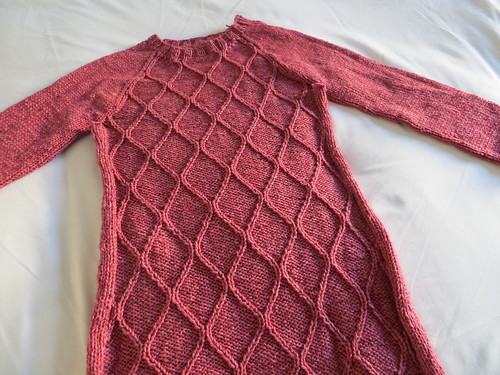
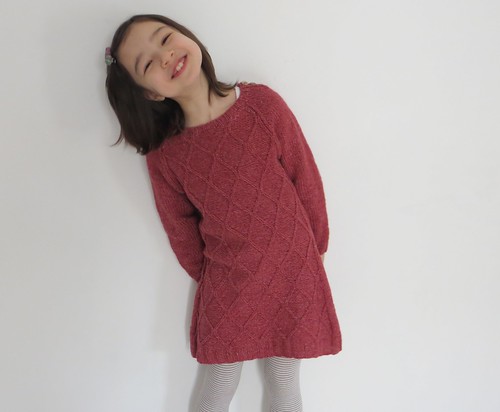
It's named Lancelot, after one of the Knights of the Round Table (please do NOT pronounce the "t"!), a pullover pattern for boys that I transformed in dress.
I don't claim the paternity of this idea: I'd seen a red and straight tunic project on Ravelry, knitted for a girl of 12 years old. But my daughter is only 7 and a half years old, and must be more active than a big girl. Hence the idea of making a dress with a flared skirt.

The pattern having a reputation of being cut small, I chose 8Y size. For the dimensions of the skirt, I was based on a dress found in a Phildar's catalog (8Y), and started with 152 sts (more sts than 12Y, the largest size) - that give me 80 cm /32" of circumference. After the hem, I decreased every 10 rnds at each side of the front panel and at 1 st from the side markers for back (- 4 sts each time). After dec til 128 sts, I increased once to have 132 sts (8Y) for waist shaping. That was also to easily follow instructions of raglan decrease.
I also modified the sleeves, beginning with less sts and increasing "evenly" to 8Y sts count - in the pattern, increases stop at the elbow.


And here's the result!
My daughter can run and/or dance!

I used Balance from o-wool, a cotton-wool blend yarn, because she's always complaining that it's hot and I was afraid she would never wear it if it's 100% wool. The balance is just perfect, neither too hot nor too cool, and this yarn is organic!

I just regret that it's a little too short and it cannot be worn as a dress next year. The sleeves are a little too large as this pattern is designed for boys. I'll certainly adjust it next year.


The last words on the pattern, that is very clearly written (in French), and the front panel motif is very addictive, simple, efficient and easier than it looks like (just 2 sts to cross!). I add that I used about 625 m - euh, 683 yards, thanks Ravelry -, instead of 600 m for 8Y size pullover.

Notes
Pattern: Lancelot by Solenn Couix-Loarer (heavily modified)
Size: 8Y (length to underarm: 44.5 cm/ 17.5", skirt length: 32.5 cm/12.5")
Yarn: O-Wool, Balance: Ruby (625 m / 683 y)
Needles: US 5 (3.75 mm) & US 6 (4 mm)
Ravelry project page | Blog post in French

Sep 25, 2014

Hari

I finally took some photos of Hari that I'd finished in... July, says my Ravelry project page! I "suppose" I wove in ends at that date, but I had some problems at blocking (and a busy summer to buy our house!)

Where should I begin?
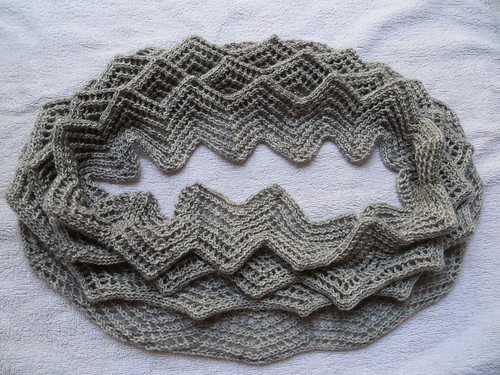
I used for this project Sock from Madelintosh which has less yardage than Tosh Merino Light used in the pattern (and I almost used up the skein, just 30 cm/12" left, that's cool). Because of this and which can often happen with lace projects, my project was really short just after the knitting. I therefore decided to make it a cowl instead of a scarf.
Grafting finished, I first soaked the work, and let it dry on a towel like a pullover. All the spikes were flattened down, it looked like a simple lace cowl... Needless to say I was super disappointed.
Crossing my fingers, I redid the blocking, letting it dry in the shape of spikes. But it's the form of cowl, a large circle, that was hard to manage. Spikes are pointed on the inner side of circle, but flatter on the outer circle. I changed, how to say, the direction? when it was yet wet - inner side on outer side and outer side on inner side.

And it's worked!!

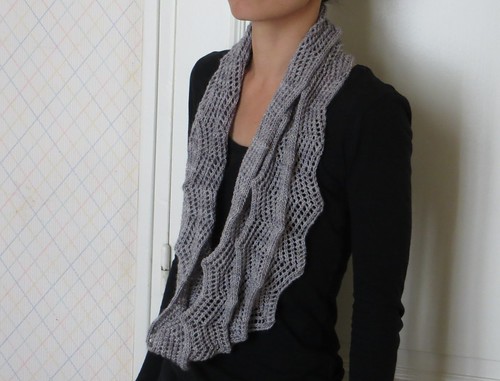
Here's the finished cowl, worn in single circle.

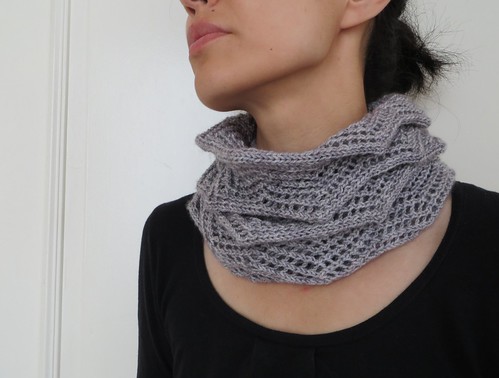
And doubled. I have a little preference for this way, we can see spikes more distinctly and it's easier to wear :)

Notes
Pattern: Hari by Olga Buraya-Kefelian
Yarn: Madelinetosh, Sock: Smokestack
Needle: 3.5 mm/US 4
Ravelry: Tension and Spikes

Sep 12, 2014

Organic Shellseeker

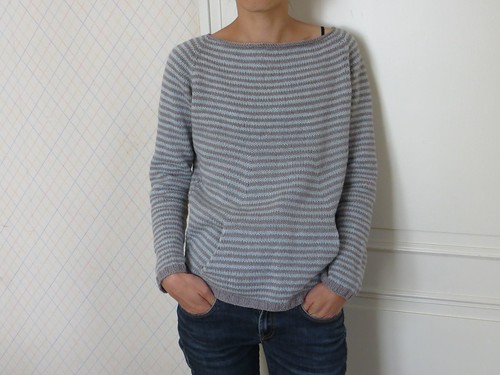
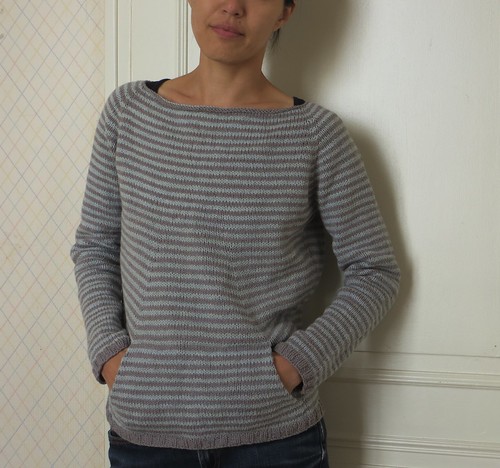
Summer holidays finished, I finally had the time to take some photos of my Shellseeker done at the start of August.


I worked this pullover with an organic cotton-merino blend yarn, it's perfect for half-season as the French say, for Spring and Autumn. I already wore it in some chilly mornings we had in France in August.

The pattern is, as usual for Heidi's patterns, very well written. I like her mathematical way with stitch count given for each section, we're never lost in her patterns. I nevertheless didn't understand the Pocket instructions the first time I read them, and obviously I was not the only one considering the discussion in Heidi's group on Ravelry. I followed the advice given on the forum, that is "follow the instructions", and I've got a nice kangaroo pocket! I think it's a terminological problem, I'd have said Bottom of pocket instead of pocket lining.


Final word on the yarn: Balance from o-wool is organic (more details on this post), as Sweater from Spud and Chloƫ recommended in the pattern, but it's more affordable! My row gauge was just a wee bit off (28 rows instead of 27), I as a result lengthened the raglan by placing last 2 inc every 4 rnds. And that is the only mod I did :)

Notes
Pattern: Shellseeker by Heidi Kirrmaier
Yarn: O-wool, Balance: Talc & Opal
Needle: US 5 (3.75 mm)
On Ravelry: Douces rayures

Fine days are back in France, I'm knitting another striped but ligther pullover ;)

Aug 19, 2014

Tender Peerie Flooers

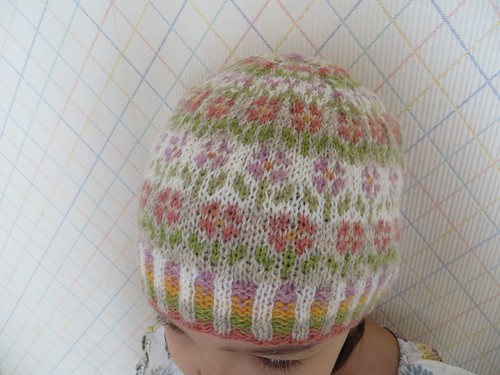
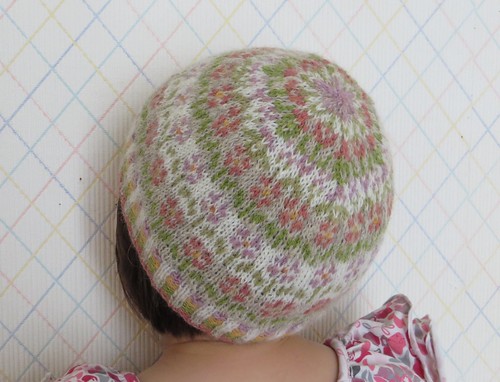
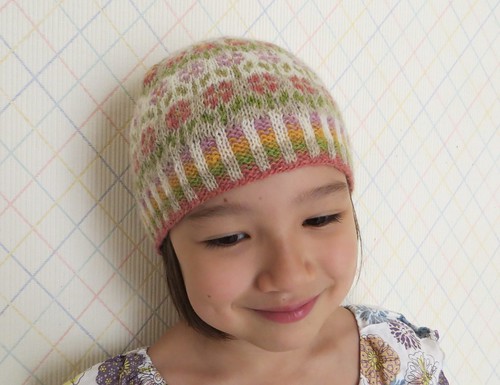
As promised, here's the photos of Peerie Flooers hat in action.

The Supersoft 100% Wool from Holst Garn has got very soft after washing: stitches have become denser and the roughness and itchiness of the yarn disappeared!

The pattern being for adult, the hat needed to be adjusted particularly in height. I started with S size, worked only 3 rows of flowers instead of 4, and rewrote the crown pattern, trying to get motifs that look like little flowers...


My daughter loves it, that's the main thing. Hope she'll wear it this winter!

Notes
Pattern: Peerie Flooers by Kate Davies
Yarn: Holst Garn, Supersoft 100% Uld: Persian Rose, Oatmeal, Calypso, Ecru, Sunrise, Sweet Pea, Verbena, Clementine
Needle: 3.25mm/US 3
Measurements: 47 cm circ x 19 cm depth before blocking, 49 cm circ x 18 cm depth after blocking
On Ravelry: Tender Peerie Flooers

May 27, 2014

Olive Larch

Some of you caught sight of it on Ravelry, here's the latest project that has fallen off my needles, Larch Cardigan by Amy Christophers.

I'd wanted to knit this cardigan for a long time. I'd have liked to try the suggested yarn, Ultra Alpaca Light from Berroco with wool and alpaca, but finding no retailer in France, I opted for Alpaca of Drops (from Norway but sold by a French retailer). This yarn with 100% alpaca fiber is very affordable if not cheap, but soft, smooth, warm, a good value for money in short. The brand says the gauge is 23 sts x 30 rows and it's classified as sport weight yarn on Ravelry, but I think the fabric obtained with this gauge is light and drapey and you can use it as a heavy fingering yarn and easily go to 26 sts/4".

I share the photo of the yarn as its color is the closest one.

Let's get back to the cardigan.
It's very classically worked from the bottom-up with set-in sleeves, but remarkable for the originality of the collar. And I love the result!
It might seem simple and easy with st st and 1x1 ribbing, but it is deceptively. The ribbing is twisted, imagine knitting and purling all sts through back loop! And I have to add that there are not a few mistakes in the pattern... If you're used to knit clothes, it's not hard to realize them. But isn't it however frustrating and all the more regrettable because the design is really nice? I listed them up on my Project page, hope it will help you.

I chose metal buttons at La Droguerie (not Paris), that have a close looking to leather buttons that I initially wanted. I was told that I would need to remove them at every wash, the choice was not hard!
The color was really difficult to capture, when I was getting closer to the fabric with my camera, the color fading...

Another photo of the cardigan with the closest color on me.

NOTES
Pattern: Larch Cardigan by Amy Christophers
Yarn: Drops, Alpaca: #7233
Needle: 3.5mm (US 4)
Ravelry page: Olive Larch

May 19, 2014

Hello! - Basic and Nice Ribbed Socks

Hi there. I'm n'ami, an addicted knitter from Japan but living in France for more then 10 years.
It's finally happened, I have a blog in English. It will be a notebook of my projects, the yarns and books I'll get, my work, etc., all about the knitting!

For the first post, I start with my latest finished object. It all began with the yarn I didn't know what to make with.
Here it is.
Dream in Color, Smooshy : Chinatown Apple


I bought it to make Pogona shawl of Stephen West, but I couldn't resist the temptation to knit this shawl with Madelinetosh Sock in Calligraphy (how can I?) that I purchased at the same time. This skein started its long sleep of hibernation.

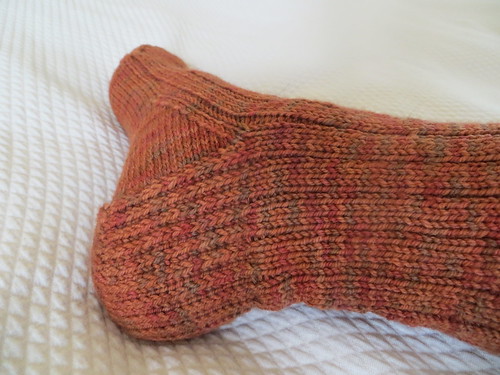
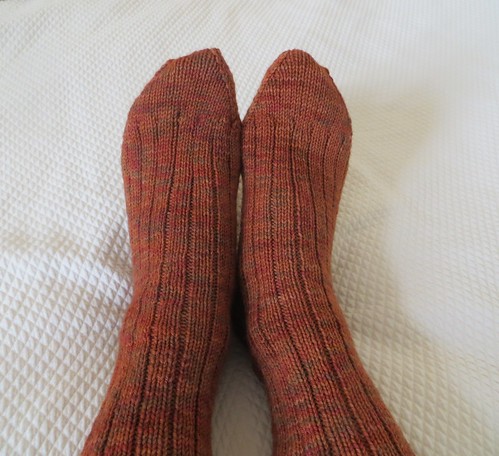
I recently decided to wake it up, it's a shame to leave a Smooshy skein aside, isn't it? For this fingering yarn with a light color variation, I thought of socks with simple stitch to show it off. I set my heart on Basic Ribbed Socks and A Nice Ribbed Socks, both in 3x1 ribbing and free on Ravelry. I finally mixed two patterns and incorporated another recipe from a Japanese book.

It's fun to knit socks, they rapidly take shape, in 3D! And the yarn is lovely to work with. I have to say that it's not so soft despite of the fiber used - 100% merino - , but smooth, bouncy, perfect for making socks. I'm quite satisfied with the result, we can see the changing colorway.


The only snag is that you see two points at toe as they're grafted with kitchener stitch there. I've understood why toe-up socks were invented. I'll try this type next time!

Notes
Pattern: A Nice Ribbed Socks & Basic Ribbed Socks
Yarn: Dream in Color, Smooshy: Chinatown Apple
Needles: 2.5mm (US 1½) DPNs

I've just taken some pictures of another fo. I'll post them shortly!

Related Posts Plugin for WordPress, Blogger...